


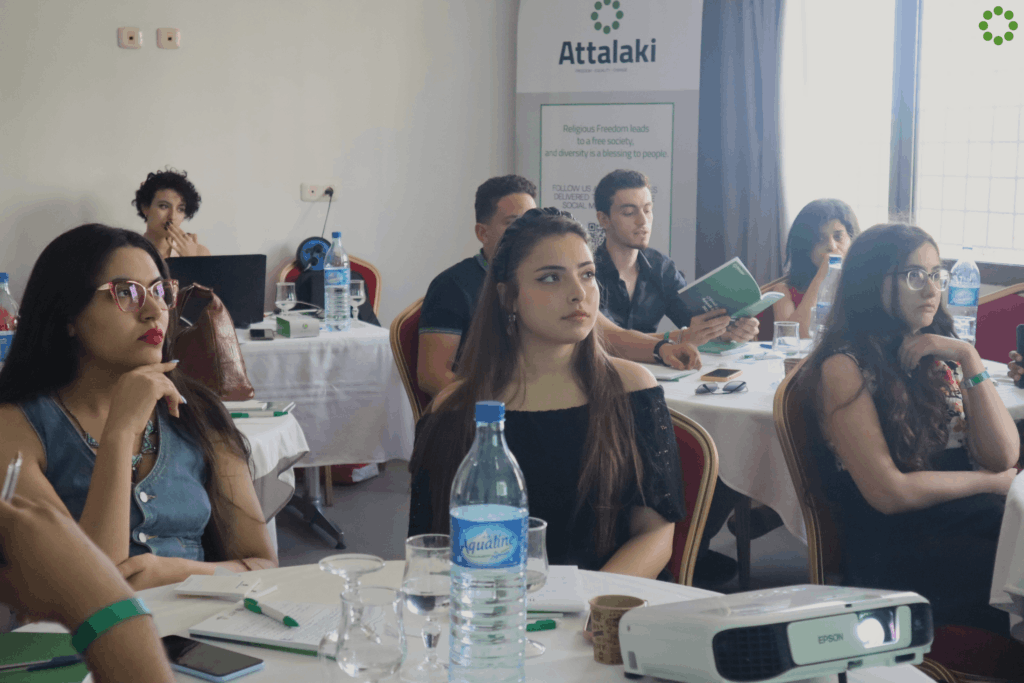
Over the course of a structured capacity-building cycle implemented between 2024 and 2026, a series of three interconnected workshops was carried out to strengthen participants’ technical understanding of project development, strategic planning, and financial management. The training was designed as a progressive methodological pathway, accompanying participants from project conceptualization to implementation planning and financial structuring.
Rather than treating these dimensions separately, the program adopted an integrated approach, linking conceptual design, strategic coherence, and financial accountability as interdependent components of effective project implementation.
The cycle was facilitated by two key experts whose complementary profiles ensured both methodological continuity and technical depth: Yassine Farhat, Program Manager at Attalaki, who led the design and strategic components, and Amira Missaoui, accounting expert for international organizations, who led the financial and compliance dimension.
I. Structuring Project Thinking: From Context Analysis to Project Design
The first phase of the training focused on strengthening participants’ ability to conceptualize structured and coherent project ideas based on results-oriented thinking.
Under the guidance of Yassine Farhat, participants were introduced to the foundational principles of project design, beginning with the importance of context analysis and problem identification as the entry point of any structured intervention. The discussions emphasized that project design is not a linear administrative requirement, but a methodological process that transforms identified needs into structured intervention logic.
Special attention was given to the internal coherence of project components, including the articulation between problem definition, objectives at different levels, expected results, and planned activities. Participants explored how consistency between these elements is essential to ensure that project proposals are both realistic and implementable.
Through applied group exercises, participants worked on translating abstract problem situations into structured project ideas, developing initial formulations of objectives and identifying key intervention areas. This hands-on approach allowed them to move from conceptual understanding to applied structuring of project logic.
The phase concluded with a collective reflection on the importance of methodological discipline in project design, particularly in contexts where organizations are required to align their proposals with structured funding frameworks.
II. Strategic Planning and Logical Coherence in Project Implementation
The second phase of the training shifted the focus toward strategic planning and analytical tools used to structure, manage, and monitor project implementation.
Building on the foundations established in the first phase, Yassine Farhat guided participants through the principles of strategic planning as a forward-looking process aimed at ensuring coherence between organizational priorities, available resources, and planned interventions.
A central component of this phase was the introduction and practical use of the logical framework approach as an analytical tool for structuring project logic. Participants explored how objectives, results, activities, and indicators are interconnected within a single coherent framework designed to support both planning and monitoring.
The training also addressed problem analysis techniques, including structured mapping of causes and effects, enabling participants to better understand the underlying dimensions of the issues they were working on. These exercises were used to reinforce analytical clarity and improve the formulation of intervention strategies.
In parallel, participants worked on distinguishing between different levels of objectives and understanding their functional role within project architecture. The importance of measurability, internal coherence, and logical sequencing was emphasized throughout.
The phase concluded with an applied exercise in which participants developed preliminary logical frameworks for their own project ideas, integrating objectives, results, and indicators into structured formats.
III. Financial Structuring, Accountability, and Project Compliance
The final phase of the training focused on financial management and compliance systems as essential components of project implementation and sustainability.
This module was led by Amira Missaoui, accounting expert for international organizations, who introduced participants to the principles of budget design, financial tracking, and reporting requirements in line with international donor standards.
The training emphasized the importance of integrating financial planning into the early stages of project design, ensuring that budget structures reflect operational realities and are aligned with planned activities. Participants were guided through the logic of budget construction, including cost estimation, categorization of expenditures, and alignment with project objectives.
Through practical group exercises, participants developed structured budgets based on previously designed project frameworks, allowing them to translate operational planning into financial structures.
The second part of the session focused on financial reporting and compliance obligations, including documentation standards, expenditure tracking, and variance analysis between planned and actual spending. Participants were introduced to reporting formats commonly required by institutional donors and the importance of maintaining accurate and traceable financial records.
The training also covered key aspects of governance and compliance, including internal financial procedures, audit requirements, and regulatory obligations. These elements were presented as essential to ensuring transparency, institutional credibility, and the sustainability of funded initiatives.
The phase concluded with a practical exercise in financial reporting, where participants analyzed budget execution scenarios and organized supporting documentation, reinforcing the importance of structured financial governance in project implementation.
Conclusion: A Progressive Methodological Learning Pathway
Across the three phases, the training cycle established a coherent methodological pathway linking project design, strategic planning, and financial management into a single integrated framework.
By combining the technical guidance of Yassine Farhat on project structuring and strategic coherence with the financial expertise of Amira Missaoui, the program provided participants with both conceptual and operational tools required for effective project development.
The progressive structure of the workshops enabled participants to move from initial project ideas to structured planning and financial articulation, reinforcing a comprehensive understanding of the project cycle as an interconnected system rather than a set of isolated technical steps.