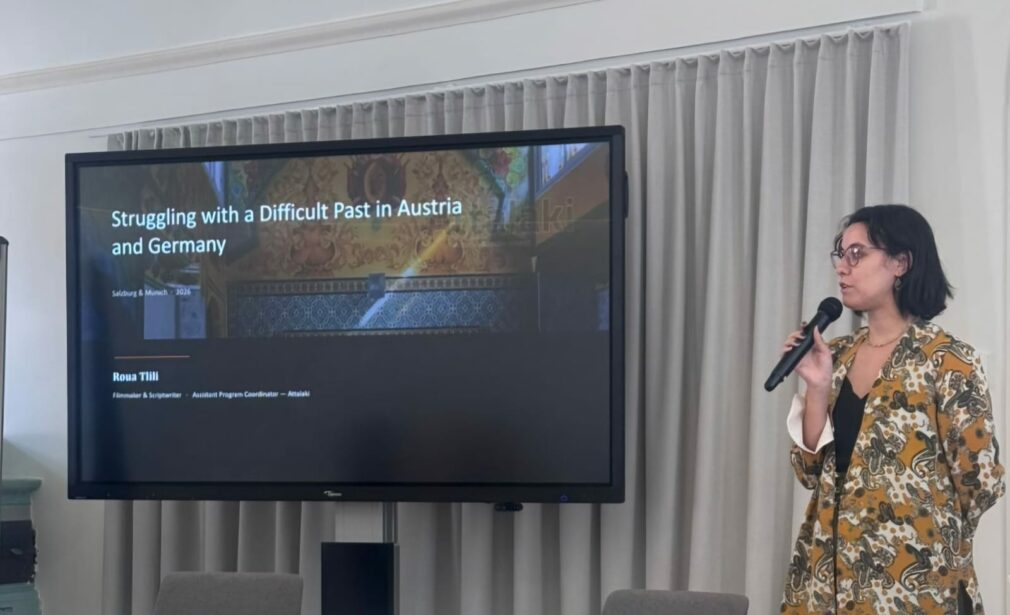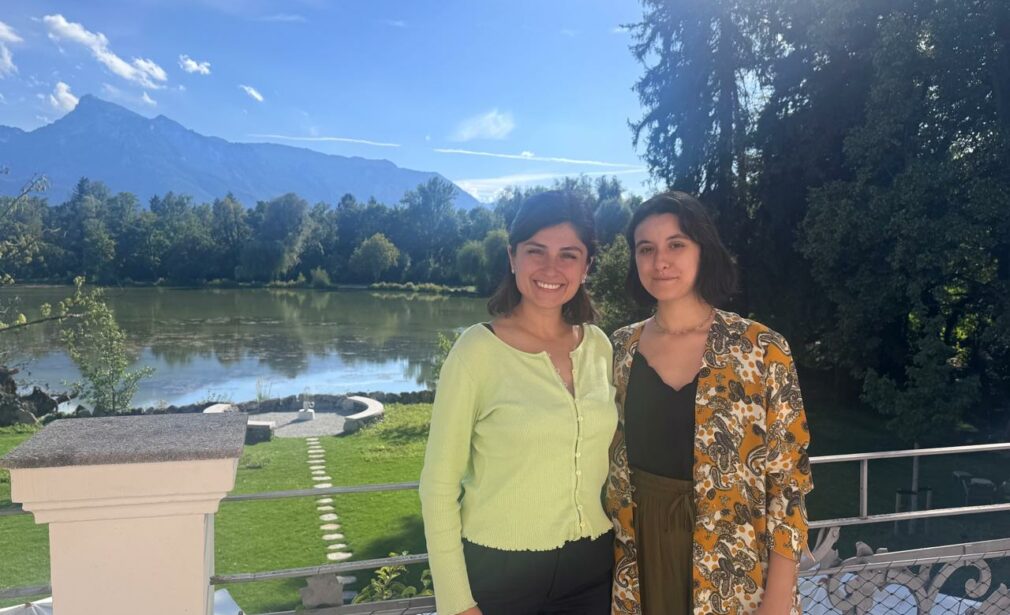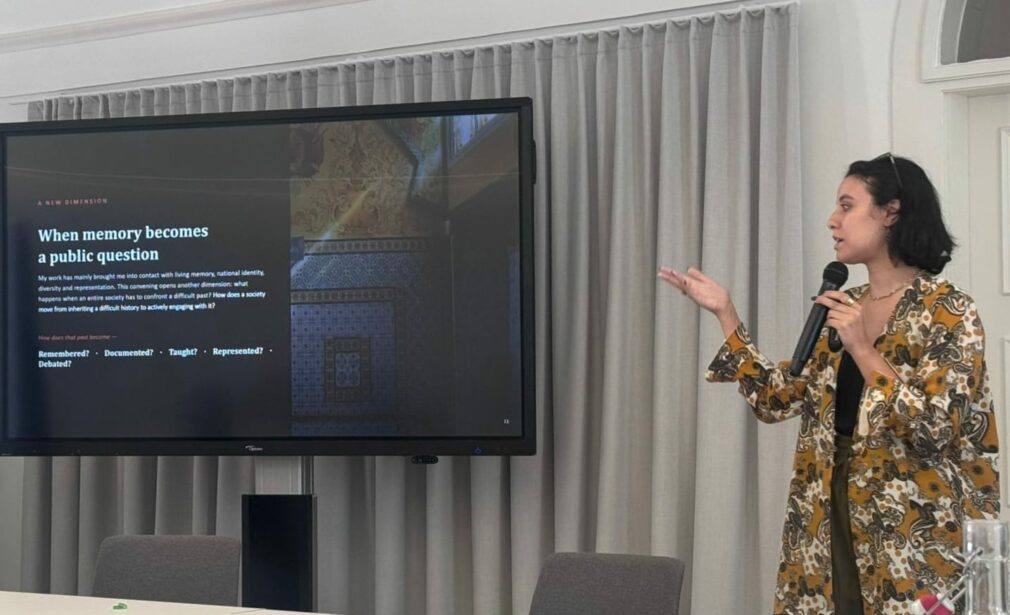


Attalaki took part in the international programme “Struggling with a Difficult Past in Austria and Germany”, held in Salzburg and Munich, through the participation of Roua Tlili, its Assistant Program Coordinator. During the programme, Roua delivered a presentation introducing the organisation’s work and sharing a Tunisian perspective on historical memory, identity and cultural representation.
Drawing on her experience in programme coordination, as well as her background as a filmmaker and scriptwriter, she explored how institutional initiatives and creative practices can contribute to the way individuals and communities engage with their past, preserve collective experiences and shape their understanding of the present.
Attalaki’s approach: making diversity visible
Founded in 2016, Attalaki works in Tunisia on freedom of religion or belief, religious and cultural diversity, inclusive citizenship and non-discrimination. Its presentation was structured around five questions: Who is seen? How are people represented? What do we know about one another? Which narratives shape our understanding? And can different experiences meet?
These questions inform the organization’s work, which combines advocacy with practical initiatives that make diversity more visible and accessible. The presentation introduced two of its digital learning platforms. Eunoia offers interactive learning units, courses and resources on historical knowledge, identity formation, cultural and religious diversity, pluralism and citizenship. Hokouk focuses on freedom of religion or belief, the rights of religious minorities and the acceptance of differences.
Roua also presented Attalaki’s audiovisual work, which uses documentary filmmaking and creative production to explore cultural and social experiences. Among the projects introduced were Pilgrims in Tunis, Pilgrims in Djerba and Trifet.
Connecting filmmaking with collective memory
A distinctive aspect of Roua’s contribution was the connection she established between her work at Attalaki and her own creative practice as a filmmaker and scriptwriter.
Through projects such as El Casino (2022), a documentary about the cultural site of El Casino in Hammam-Lif, and Threads of Memory (2025), she has explored the relationship between people, places, identity and memory. El Casino received the Best Documentary award at MIFF 2022 and Cinémana 2023, and was screened at the Carthage Film Festival (JCC).
Drawing on these experiences, Roua reflected on how individual stories can carry traces of wider social and historical experiences. Places, personal accounts, silences and shared memories all contribute to how communities understand their identities and the changes they have undergone.
Her presentation brought these two professional perspectives together: Attalaki’s work on diversity and inclusion, and filmmaking’s capacity to document experiences, preserve stories and make complex subjects accessible.
Learning across different historical and social contexts
A central message of the presentation was that experiences and approaches developed in one country cannot simply be transferred to another. Roua emphasized the importance of understanding the specific historical, cultural and social context before considering how an educational or institutional approach might be adapted elsewhere.
This perspective was particularly relevant to the programme’s discussions, which explored how societies engage with their past, how historical experiences are remembered and transmitted, and the challenges of addressing these questions through public and educational initiatives.
Through presentations, workshops, group discussions and visits in Salzburg and Munich, participants examined different institutional approaches, shared experiences from their respective countries and reflected on the relevance of these practices in their own professional contexts. The programme also provided opportunities to exchange ideas on cultural initiatives and explore possibilities for future collaboration.
By bringing a Tunisian perspective into these exchanges, Roua highlighted the importance of recognizing differences between national contexts while remaining open to learning from one another. The objective is not to reproduce a model developed elsewhere, but to identify relevant questions, approaches and practices that can be meaningfully understood within each society.
A contribution rooted in Tunisia’s experience
Through Roua‘s participation, Attalaki shared its experience in promoting cultural and religious diversity, developing educational resources and using audiovisual production to bring different social experiences into public view.
Her contribution highlighted the value of combining institutional work with creative practices when engaging with questions of identity, memory and representation. It also offered participants an opportunity to consider these subjects through the lens of Tunisia’s own historical and social realities.
For Attalaki, participation in international exchanges provides an opportunity to share its experience and institutional expertise, engage with approaches developed in different national contexts, and contribute perspectives from Tunisia and North Africa to broader discussions on historical memory, cultural representation and social development.