


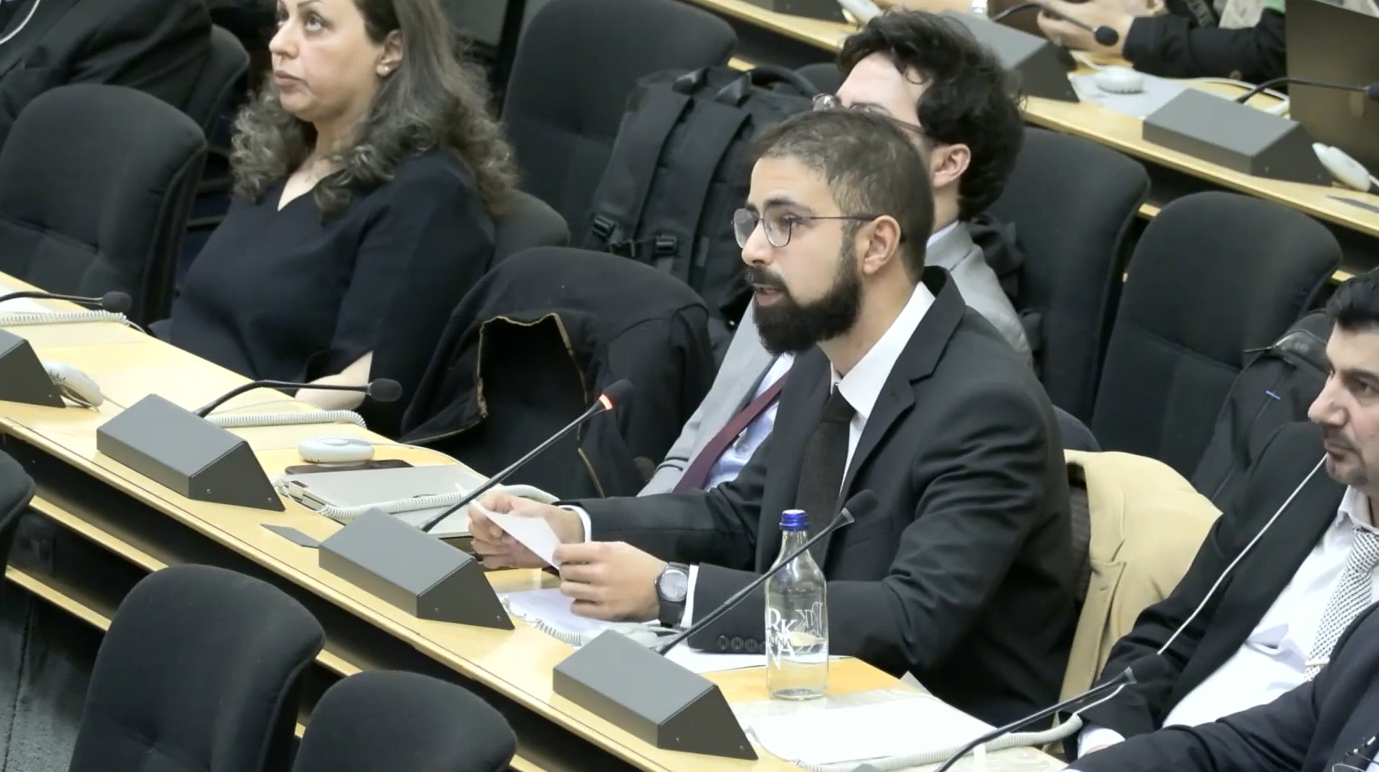
The United Nations Forum on Minority Issues, created in 2007 by Human Rights Council resolution 6/15, is one of the Council’s key mechanisms for examining the situation of minorities worldwide. It provides a structured space for states, experts, NGOs, and minority representatives to discuss challenges, share practices, and formulate recommendations that feed directly into UN processes and national policy debates.
Within this framework, Attalaki delivered its intervention during the 18th Session of the Forum, held at a time when many societies are experiencing heightened polarization and a narrowing of civic space. For Attalaki, a Tunisian and MENA-based organization working on dialogue, pluralism, and the protection of religious minority rights, participation in this Forum represents more than visibility. It is an opportunity to contribute field-based expertise to an international mechanism that influences both global discourse and national reforms.
Ghassen Ayari delivered Attalaki’s statement at the Forum, held at the United Nations headquarters in Palais des Nations, Geneva, representing the organization alongside Yassine Farhat, both from the Program Development and Management team.
In its statement, Attalaki highlighted the importance of a multi-level, multi-stakeholder approach to minority rights protection. Drawing on its experience in Tunisia and the region, the organization stressed that effective protection requires cooperation between communities, civil society, public institutions, religious leaders, and academic actors. This aligns with the Forum’s long-standing recognition that minority rights cannot be detached from broader issues of governance, education, and social cohesion.
Attalaki also framed Tunisia as an example of a country where diversity is present but remains sensitive. Local initiatives—whether educational programs, community workshops, or dialogue efforts—demonstrate that inclusive practices can be scaled into regional cooperation models when supported and sustained.
Bilateral Engagement Beyond the Statement
As with many UN mechanisms, participation extended beyond the official intervention. Attalaki held a series of bilateral meetings before, during, and after the Forum, aimed at exchanging information, strengthening networks, and identifying areas for collaboration. These discussions are an essential part of international advocacy, ensuring that recommendations translate into concrete follow-up and long-term partnerships.
This quiet diplomacy is often where the groundwork for future cooperation is established.
Attalaki’s presence at the 18th UN Forum contributes to ongoing debates about diversity management in Tunisia and the wider region. It reinforces a shared understanding among human rights actors that minority rights are central to social stability and democratic resilience. By bringing local insights into UN discussions, where outcomes inform Human Rights Council deliberations, treaty body work, and national policy developments, Attalaki helps maintain space for dialogue.
Ultimately, this participation underscores that minority rights advocacy is not only about identifying challenges. It is also about proposing solutions, building alliances, and promoting approaches that treat diversity as a collective responsibility rather than a source of division.